Spices of Sri Lanka
Nutmeg & Mace
Saadikka · Wasawasi · two spices from one fruit
Ayubowan! Today, let us open a small golden fruit that holds not one spice, but two. Nutmeg and mace, or saadikka and wasawasi in Sinhala. What they are, how they grow in Sri Lanka, and what they may do for our health.
The film
Nutmeg & Mace
What it is
One fruit, two spices
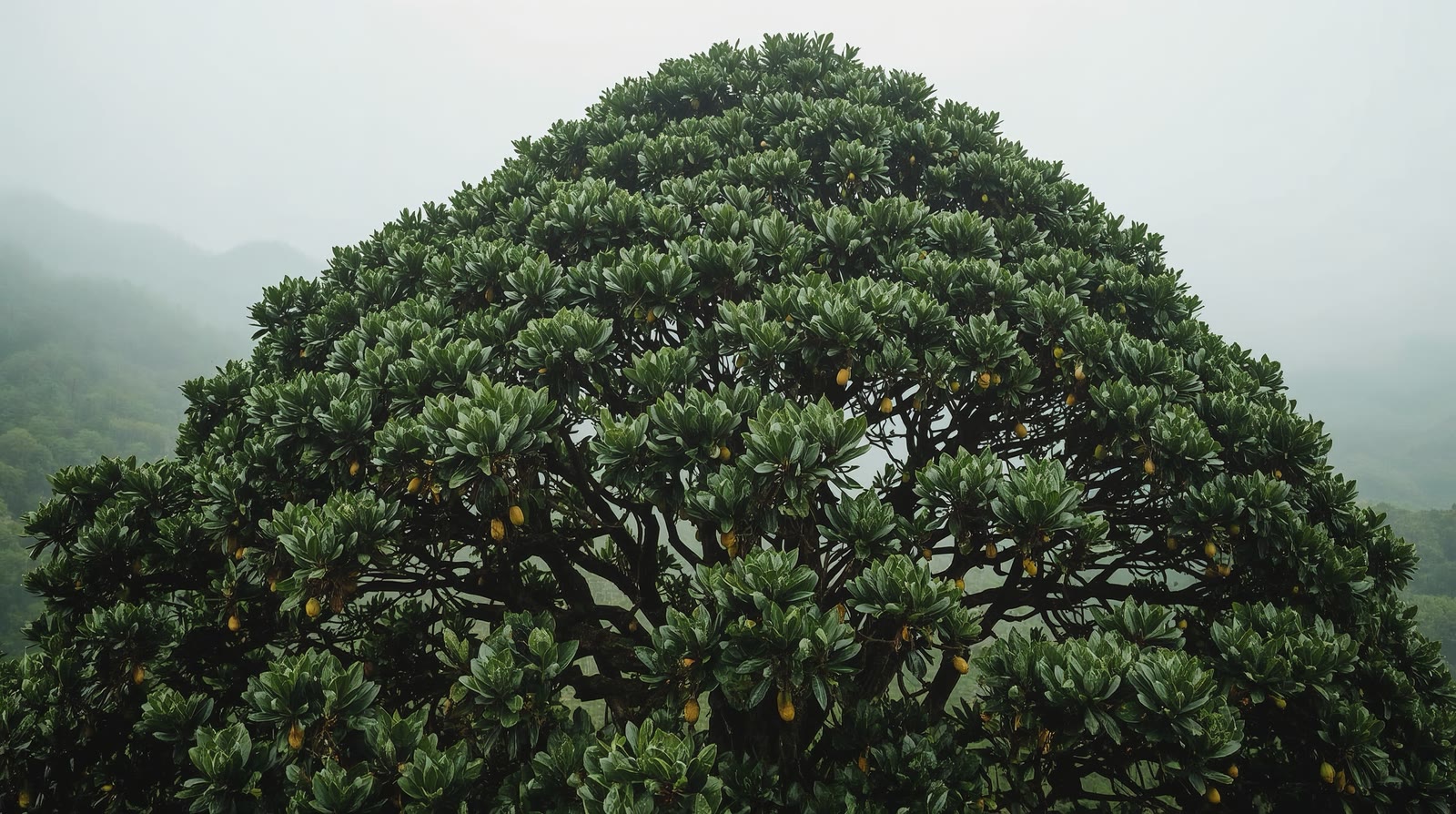
Nutmeg grows on an evergreen tree with dark, glossy leaves. Scientists call it Myristica fragrans.
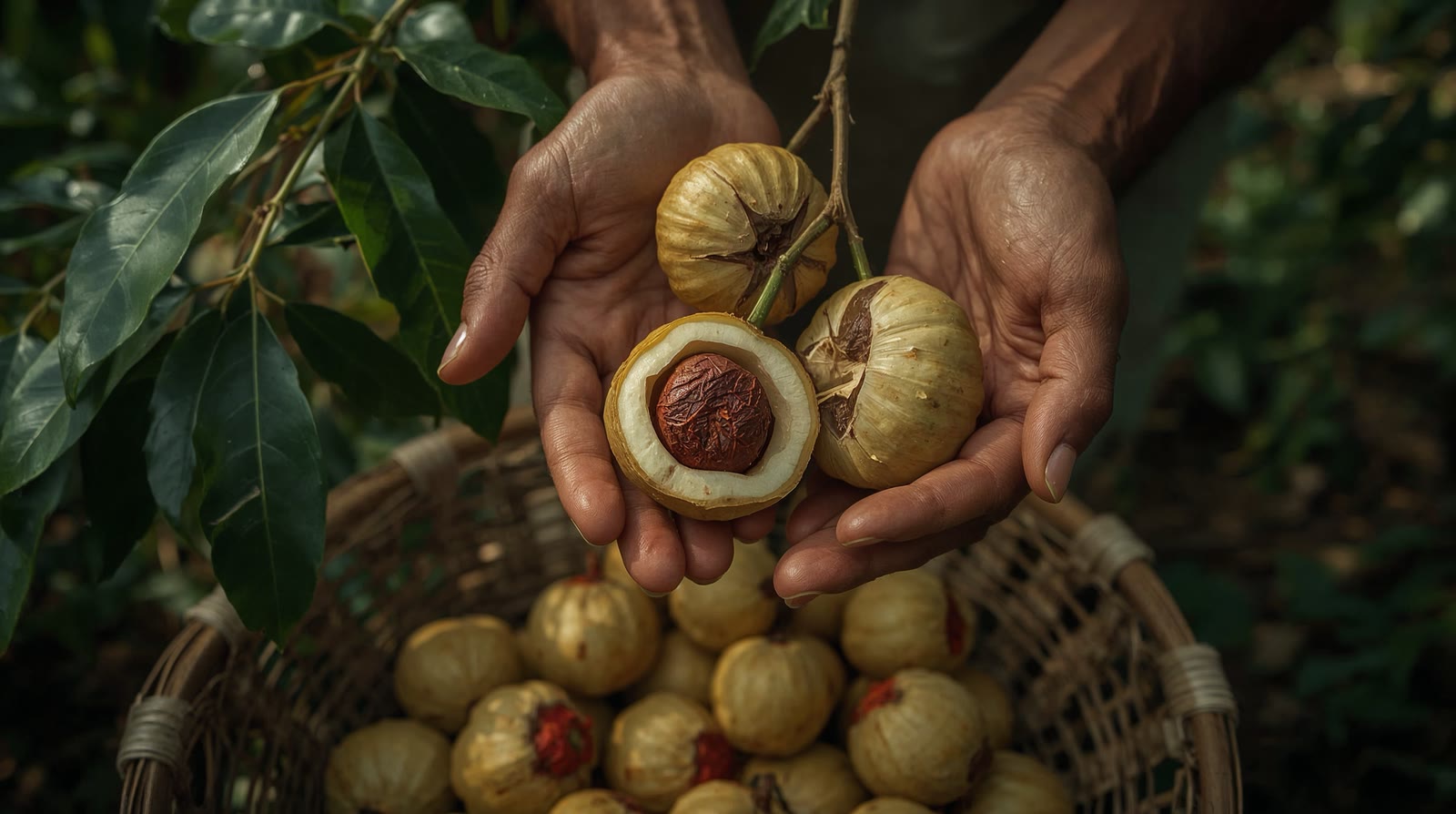
Its fruit is round and fleshy. As it ripens, it turns yellow, and then splits open by itself.
And inside, there is a surprise: two different spices, from just one fruit.
- The tree
- An evergreen tree, dark glossy leaves
- Scientific name
- Myristica fragrans
- The fruit
- Ripens yellow, then splits open
- Two spices
- Nutmeg and mace
A closer look
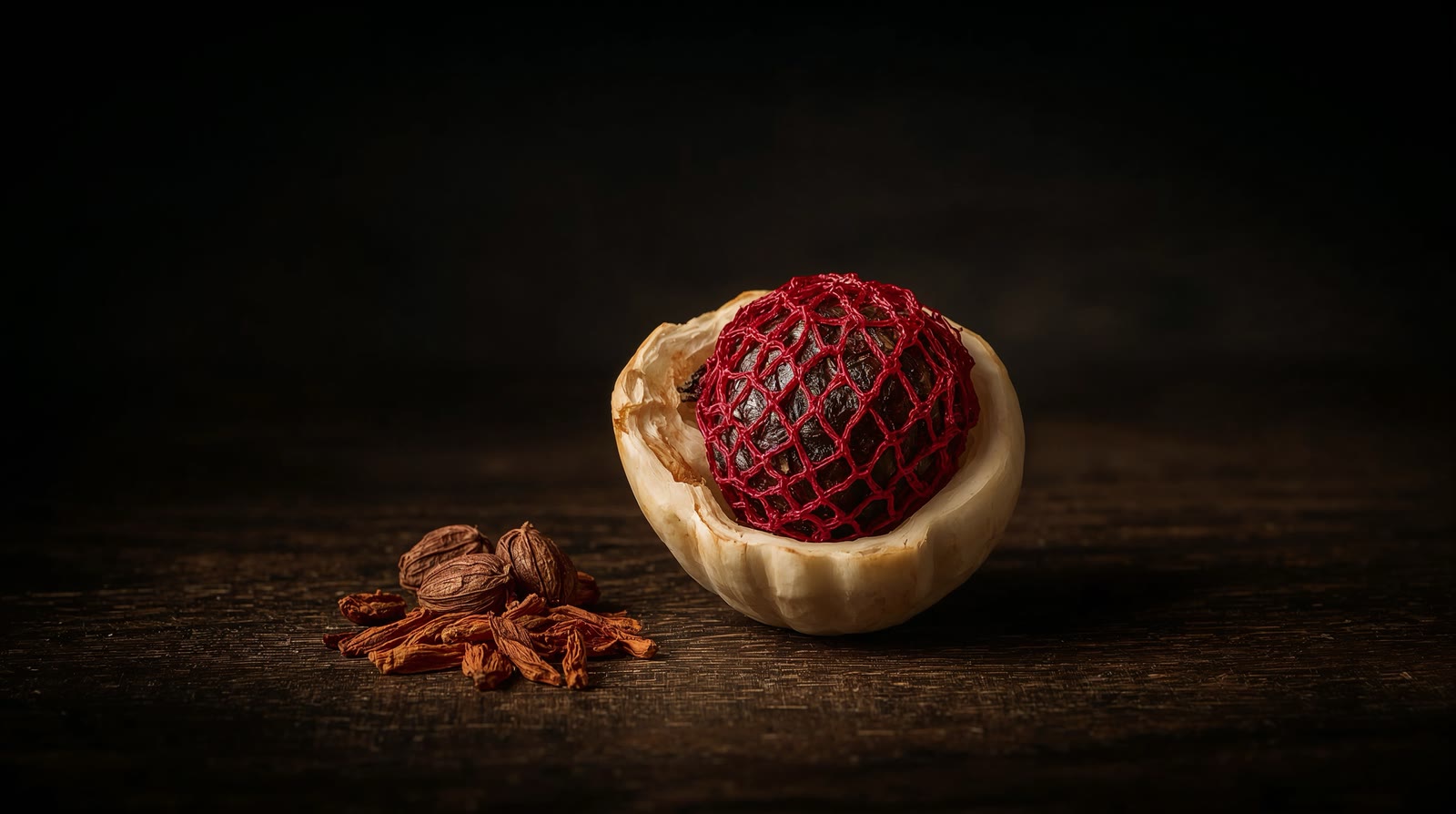
Inside the fruit
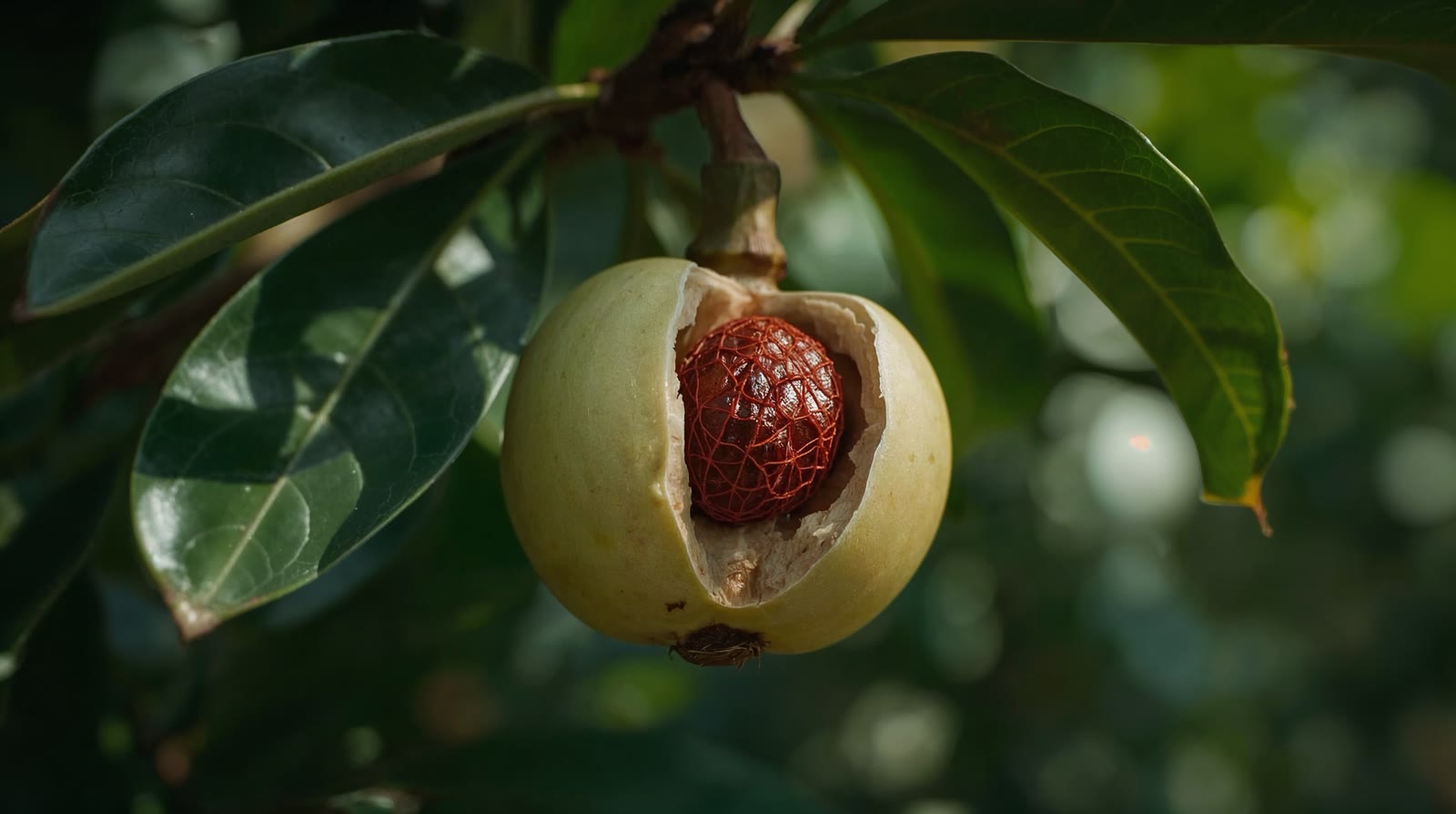
Let us cut one open, and look at its layers.
Outside is the thick, pale flesh of the fruit.
Next, a bright red, lacy net is wrapped around the seed. This is mace.
Under the mace is a thin, hard, dark brown shell.
And inside the shell is the seed itself. This is nutmeg.


History
From the Spice Islands
Nutmeg's first home is the Banda Islands of eastern Indonesia, a tiny group of volcanic islands among the famous Spice Islands.
On one of these islands, archaeologists found traces of nutmeg on pieces of pottery about three thousand five hundred years old. It is the oldest known sign of people using it.
For centuries, these few islands were the only place in the world where nutmeg was grown. In the sixteen hundreds, Dutch traders seized them by force, to keep the spice for themselves.
In sixteen sixty-seven, a peace treaty left the Dutch with Run, one tiny nutmeg island, while the English kept a small town in America, New Amsterdam. Today, we call it New York.
- First home
- Banda Islands, Indonesia
- Oldest evidence
- Traces on pottery about 3,500 years old
- 1600s
- Dutch traders seize the islands
- 1667 · Peace treaty
- Dutch keep Run; English keep New Amsterdam
- Today
- New Amsterdam is today's New York
In Sri Lanka
At home in the hills
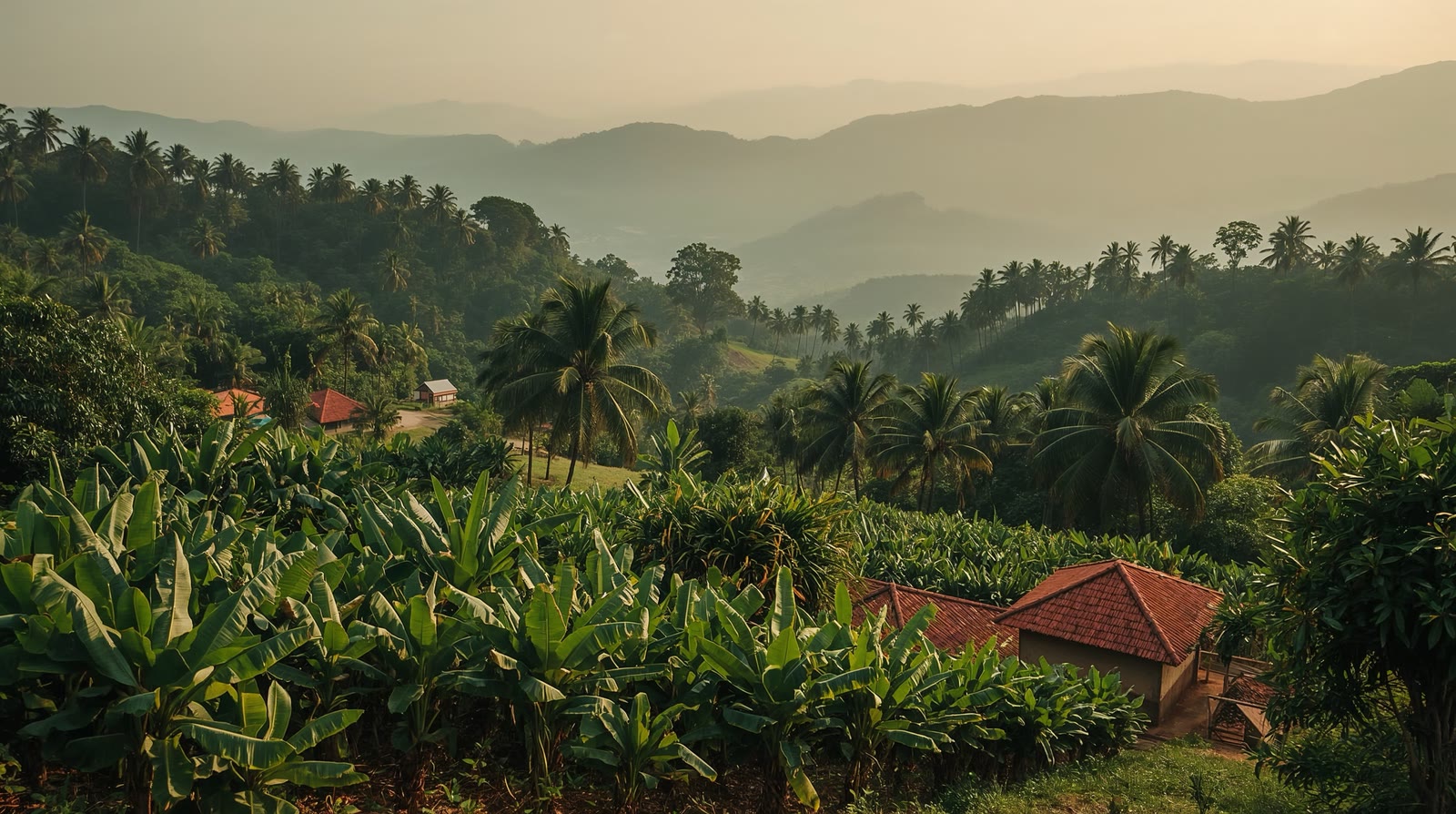
Later, the British carried nutmeg to other lands, and early in the eighteen hundreds it was planted in Sri Lanka. Some believe merchants brought it here even earlier.
Nutmeg likes the cooler mid-country. About eighty percent of it grows in the Kandy district, and more in Kegalle and Matale.
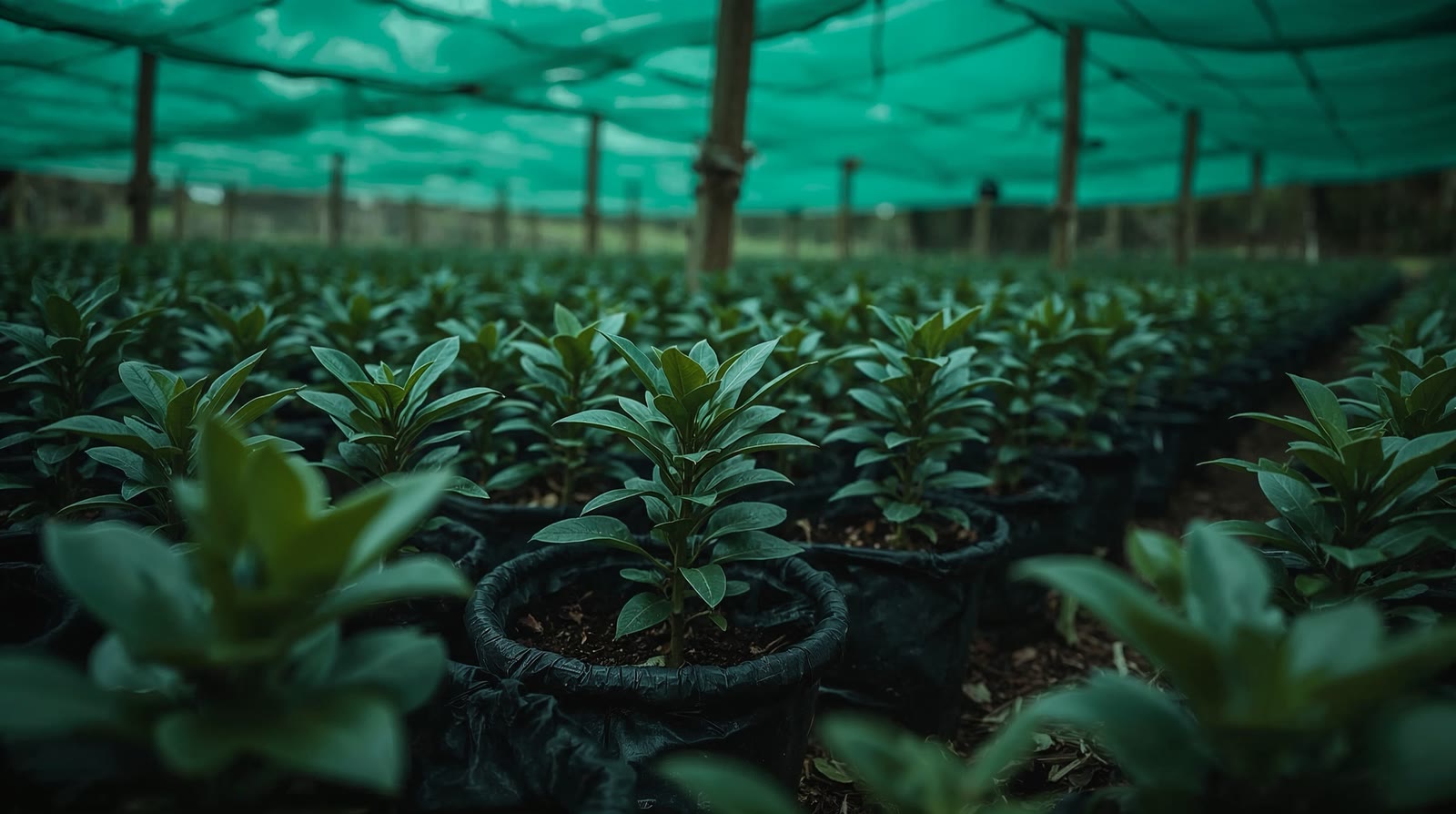
It needs well-spread rain, warm days, and shelter from strong winds. Young trees also need shade for their first three years.
- Arrival
- Planted early in the 1800s
- Where it grows
- The cooler mid-country
- Climate
- Even rain, warm days, no strong wind
- Young trees
- Shade for the first three years
Growing nutmeg
Male and female trees
Here is something unusual. Nutmeg trees are either male or female. Only the female trees bear fruit, but the males are needed for their pollen.
A young seedling gives no clue. Only when it flowers do we know, and about half of the seedlings turn out to be male.
So farmers keep about one male tree for every ten female trees. Grafting branches from good female trees also helps, because the new tree will bear fruit.
A tree starts bearing in about its seventh year, gives its best after about twenty years, and can keep fruiting for over a hundred years.
- Female trees
- Only female trees bear fruit
- Male trees
- Male trees give the pollen
- In the field
- About 1 male for every 10 females
- Sure to bear fruit
- Grafts from good female trees
The harvest
From fruit to spice
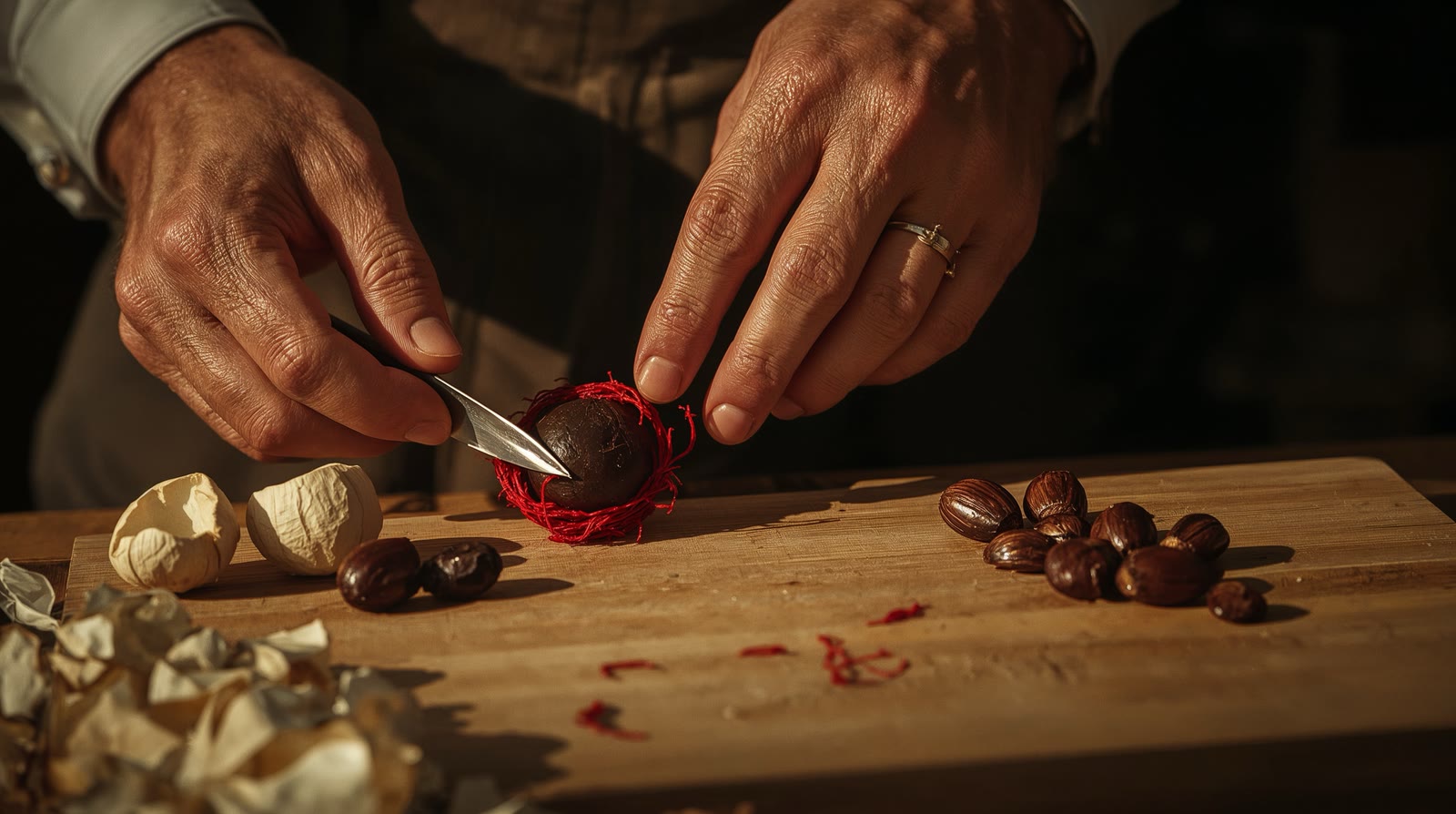
The fruits are picked by hand when they split open, or are just about to.
Then the red mace is gently cut away from the nut with a small, pointed knife.
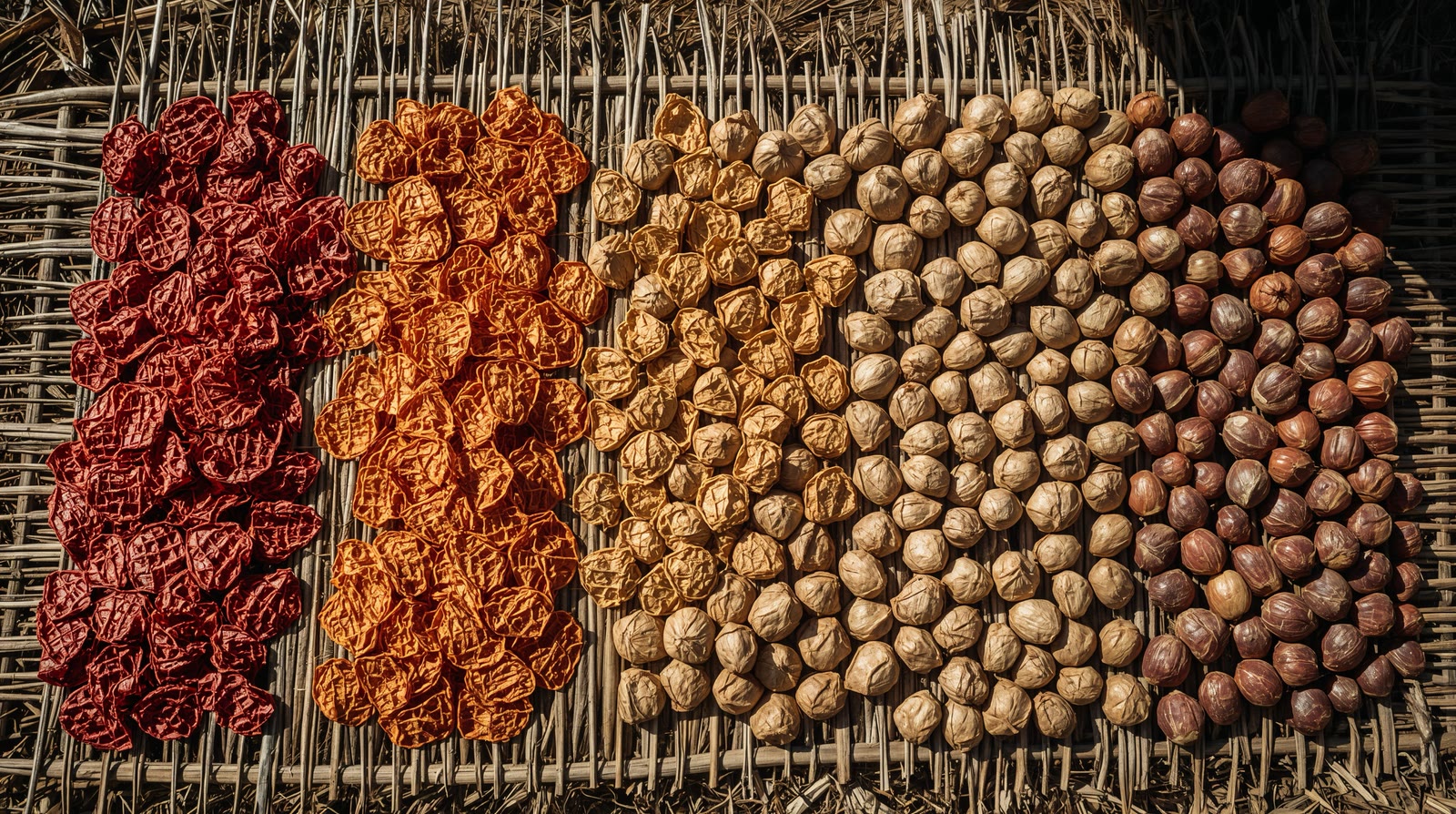
The mace is pressed flat and dried slowly in the sun. Its bright red slowly turns orange-yellow.
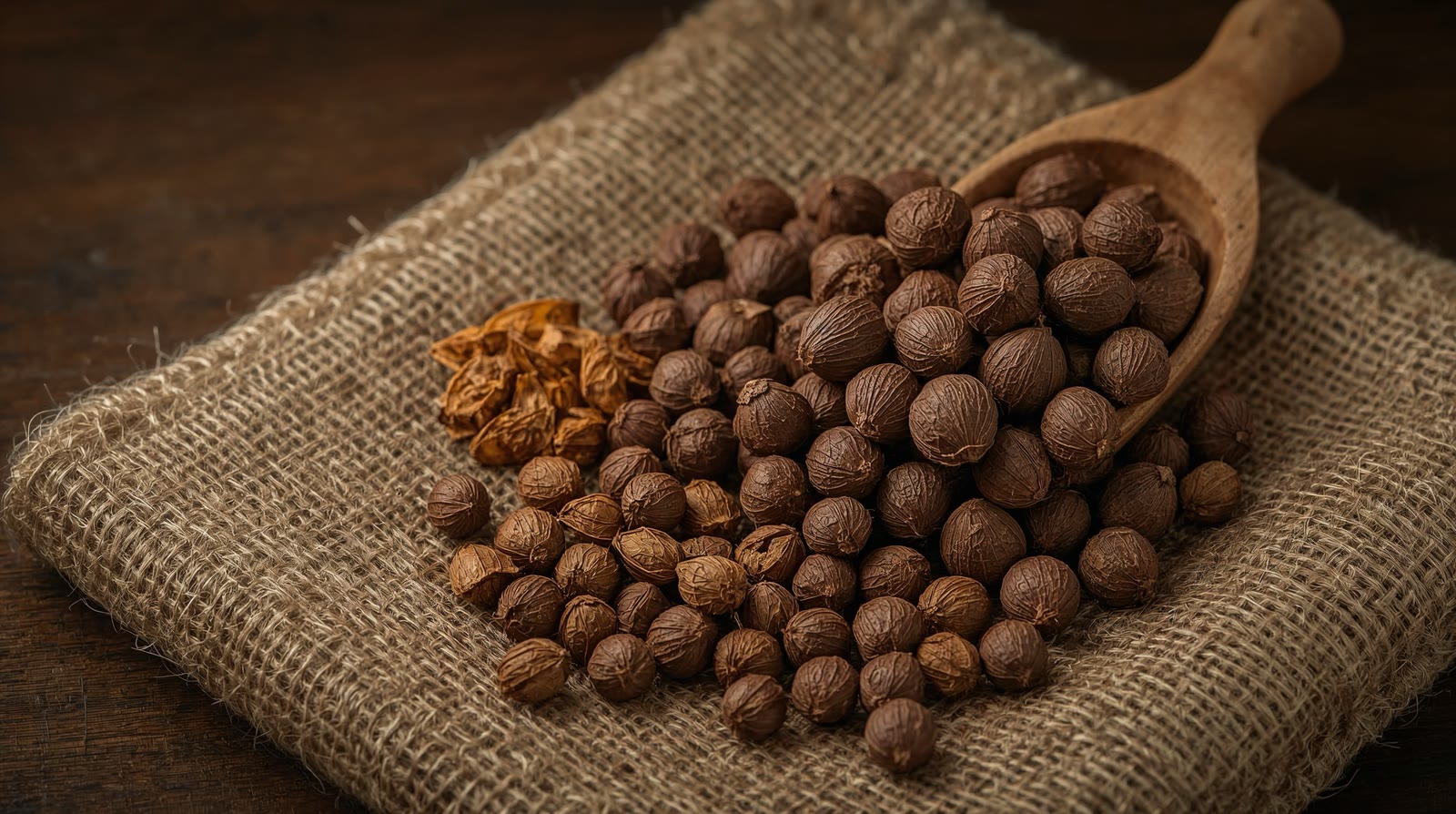
The nut dries in its shell for several weeks, until the seed inside rattles when you shake it.
- Harvest
- Picked by hand as it splits
- Separating
- Mace cut away with a small knife
- Mace
- Pressed flat and sun-dried
- Nutmeg
- Dried in its shell for weeks
What a tree gives
Plenty of nutmeg, little mace
An average tree in Sri Lanka gives about fifteen hundred dried nutmegs a year. The very best can give up to ten thousand.
But look at the weights. From a good fresh fruit, the nut weighs about ten grams, and its mace only about one gram.
That is why there is far less mace than nutmeg.
- An average tree
- About 1,500 dried nutmegs a year
- The very best trees
- Up to 10,000
- So
- Far less mace than nutmeg
Taste and aroma
The oil and the butter
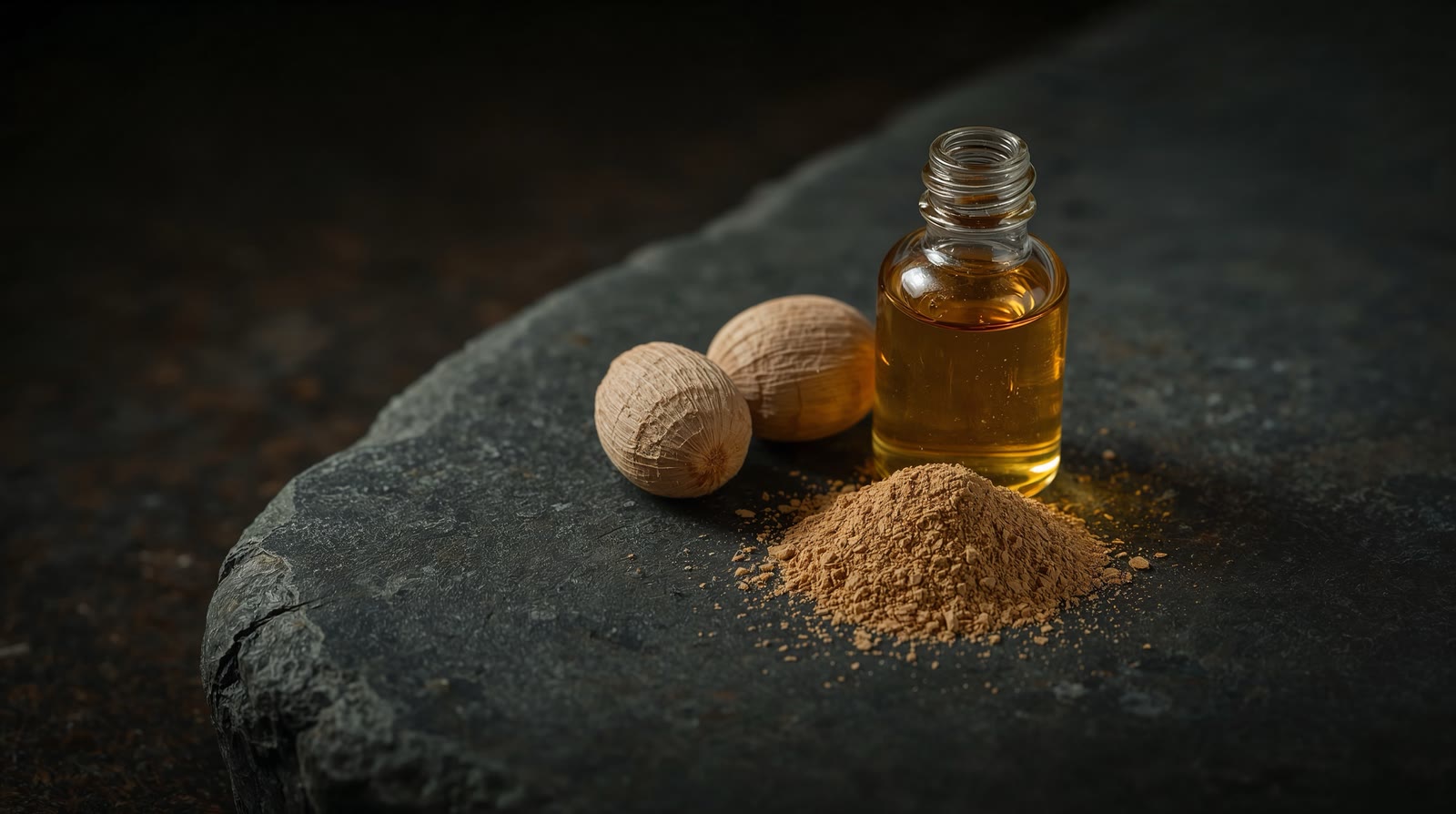
Nutmeg tastes warm and sweet. Mace is softer and more delicate.
Their aroma comes from an essential oil. A nutmeg can hold up to sixteen percent of it.
Nutmeg is also rich in fat, up to forty percent of the dried seed. Pressed out, it becomes nutmeg butter, used in soaps and creams.
The oil holds many natural compounds, such as sabinene, pinene and myristicin.
- Taste
- Nutmeg warm and sweet · mace softer
- Natural compounds in the oil
- Sabinene · pinene · myristicin
Tradition and home
From healing to the kitchen
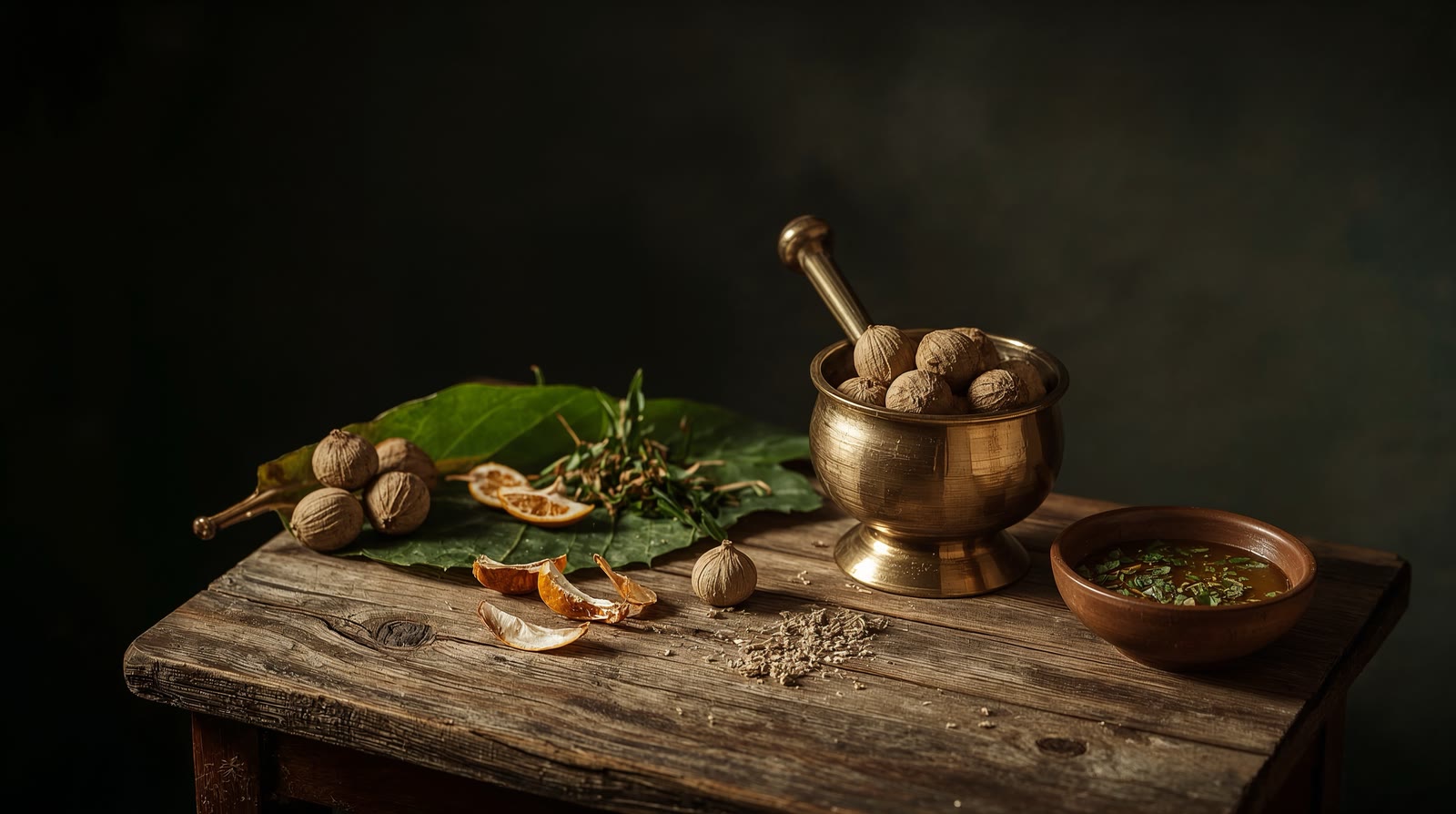
In Ayurveda and traditional Chinese medicine, nutmeg has long been used, especially for digestion, wind and an upset stomach.
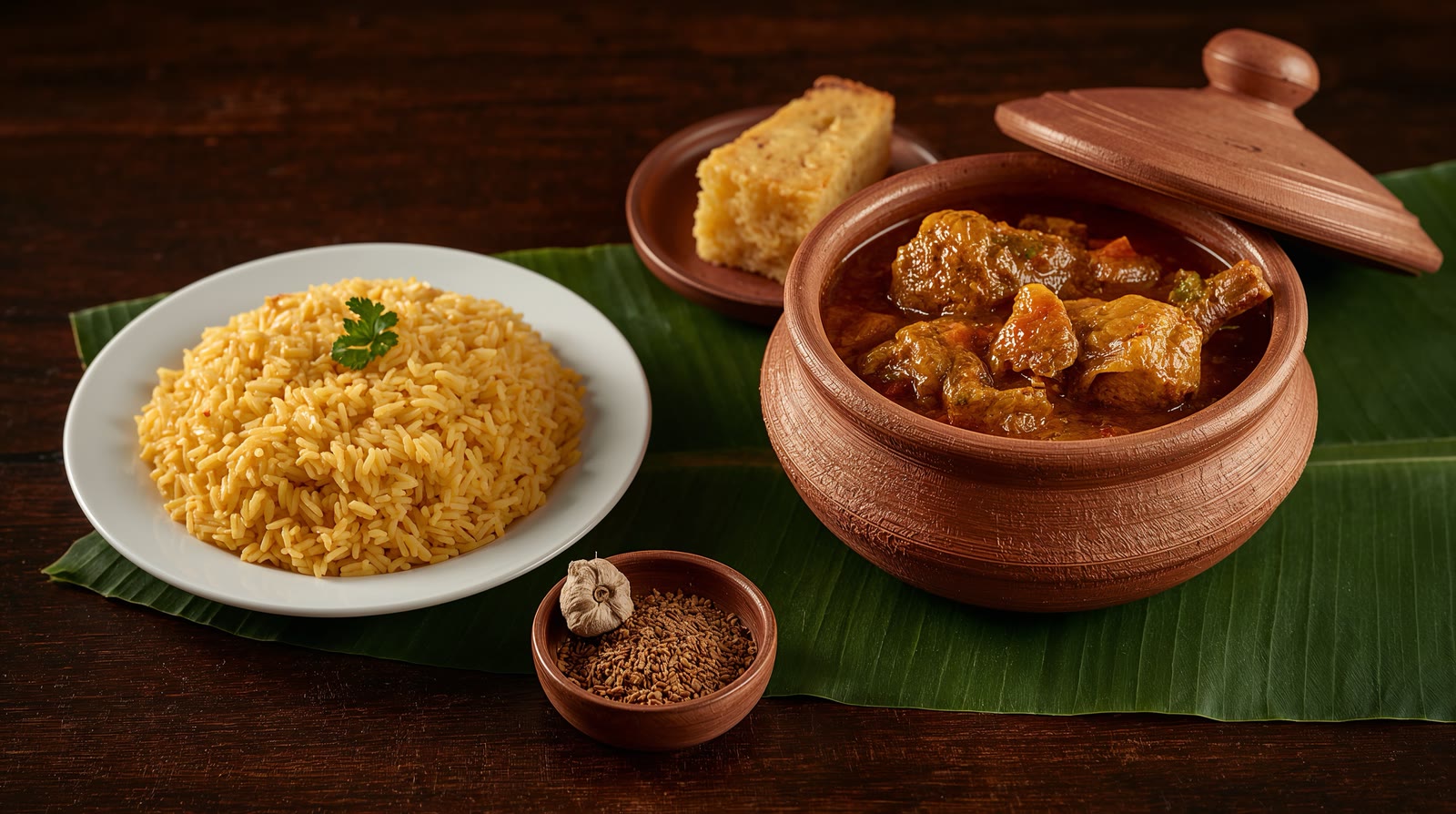
In our kitchens, a little grated nutmeg or mace flavours curry powders, cakes and sweets, and even warm drinks.
Only a small pinch is needed, because its flavour is strong.
- Long used in
- Ayurveda and Chinese medicine
- Especially for
- Digestion, wind, upset stomach
- In the kitchen
- Curry powders, cakes, sweets, warm drinks
- Strong flavour
- Only a small pinch

Research
What does research say?
So, what does research say about its benefits?
In the laboratory, nutmeg and mace extracts act as antioxidants, and slow the growth of many kinds of bacteria and fungi.
One compound from mace, macelignan, stopped a tooth-decay germ in laboratory tests.
Studies in animals also point to calmer inflammation, and protection for the liver.
But careful studies in people are still very few. So, for now, these benefits are promising, not proven.
- Laboratory tests
- Antioxidant; slowed bacteria and fungi
- From mace · laboratory
- Macelignan stopped a tooth-decay germ
- Animal studies
- Less inflammation, liver protection
- But
- Few human studies: promising, not proven
Nutmeg & Mace
Two spices, one fruit
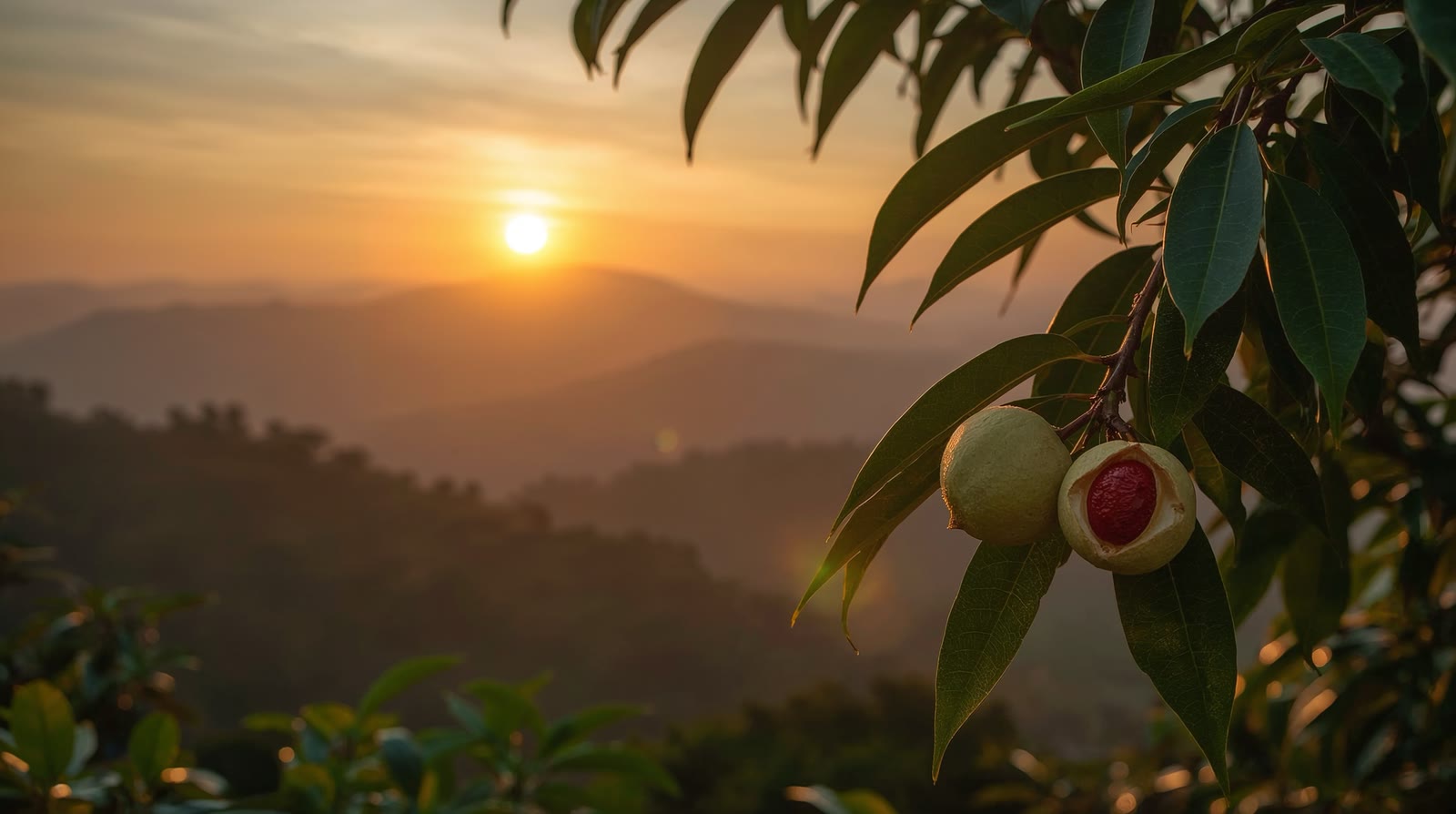
Nutmeg and mace. Two spices from one golden fruit, grown in the cool hills of our island.
Small, strong, and full of history. Worth knowing, and worth protecting.
For general education only. This is not medical advice. Nutmeg is a spice for small amounts: large amounts are poisonous, so keep it away from children. Images are AI-generated illustrations, not documentary photographs.